Mortgage Loan (Loan Against Property) in India: The Complete Legal Guide

A mortgage loan — commonly known as a Loan Against Property (LAP) — involves pledging an existing immovable property as collateral to raise funds for business, personal, or other needs. Because it is a secured facility, the legal consequences of default are more severe and faster-moving than for unsecured loans, and borrowers who fall behind can quickly find themselves caught in a debt trap with mounting interest, fees, and recovery pressure. This guide explains the legal framework governing mortgage loans in India — from creation of the mortgage to enforcement, borrower rights, and where to get legal help for loan and debt settlement when repayment becomes difficult.

What Legally Constitutes a Mortgage Loan?

A mortgage, under Section 58 of the Transfer of Property Act, 1882, is the transfer of an interest in specific immovable property to secure the repayment of a loan. Common forms used by lenders include:

Equitable mortgage — created by depositing title deeds with the lender, without registration; common for LAP.

Registered mortgage (simple or English mortgage) — requires registration and stamp duty, often used for higher-value or commercial properties.

The mortgage loan agreement runs alongside the mortgage deed, and both documents together create the lender’s enforceable security interest.

Governing Legal Framework

1. Transfer of Property Act, 1882 — defines and governs the creation, rights, and enforcement of mortgages.

2. Indian Contract Act, 1872 — governs the underlying loan contract.

3. SARFAESI Act, 2002 — the primary enforcement mechanism for banks and NBFCs once the loan turns into an NPA.

4. Recovery of Debts and Bankruptcy Act, 1993 — governs proceedings before the Debts Recovery Tribunal (DRT).

5. Registration Act, 1908 — governs registration and stamp duty requirements for registered mortgages.

6. RBI guidelines on LAP and the Fair Practices Code — govern loan-to-value ratios, disclosure, and recovery conduct, including limits on how aggressively recovery agents can pursue defaulting borrowers.

Key Clauses to Understand Before Signing

Loan-to-Value (LTV) ratio clause — determines how much can be borrowed against the property’s assessed value.

Cross-collateralisation clause — some lenders link the mortgaged property as security for multiple facilities.

Acceleration clause — entitles the lender to demand the full outstanding amount on a single default.

Insurance covenant — often requires the borrower to keep the property adequately insured throughout the tenure.

Sale/transfer restriction — most mortgage agreements bar the borrower from selling or further encumbering the property without the lender’s consent.

It’s worth reading these clauses closely at the outset. Many borrowers only discover the true cost of a mortgage loan once banks and NBFCs’ higher interest rate practices — steep penal interest, processing charges, and foreclosure fees buried in the fine print — start compounding after a missed EMI or two, pushing an otherwise manageable loan into a genuine debt trap.

Legal Process on Default

1. NPA Classification after 90 days of default, as per RBI norms.

2. Section 13(2) Demand Notice under SARFAESI, giving the borrower 60 days to repay.

3. Borrower’s Objections {Section 13(3-A)} must be considered and responded to by the lender.

4. Possession under Section 13(4) — symbolic or physical possession of the mortgaged property, followed by valuation and public auction.

5. Appeal to DRT (Section 17) — the borrower’s primary legal remedy against SARFAESI action, to be filed within 45 days of the measure being taken.

6. Sale Certificate and Transfer — once the auction is confirmed and full payment is received, the lender issues a sale certificate to the auction purchaser.

Where the loan does not meet SARFAESI’s applicability criteria (for instance, certain unregistered or informal lenders), recovery must proceed through a civil suit for recovery and, if necessary, execution proceedings — a considerably slower route.

When Recovery Turns Into Harassment

Even within this legal framework, borrowers frequently report loan recovery conduct that crosses the line — repeated late-night calls, visits to the workplace, threats, or attempts at intimidation. This kind of recovery harassment is not permitted under RBI’s Fair Practices Code, regardless of how far behind a borrower has fallen. If you are facing this, documenting each instance and seeking timely legal advice is the first step toward stopping it.

Borrower Rights and Protections

● Right to a copy of the mortgage deed and loan agreement.

● Right to receive the statutory 60-day notice before any enforcement action.

● Right to a fair and transparent valuation of the property before sale.

● Right to redeem the mortgage by clearing dues before the auction sale is finalised.

● Right to receive any surplus sale proceeds after the lender’s dues, interest, and costs are settled.

● Protection against coercive recovery tactics under RBI’s Fair Practices Code.

What to Do If You’re Struggling to Repay

A mortgage default doesn’t have to end in the loss of your property. Depending on your situation, a structured debt settlement — negotiated directly with the bank or NBFC, or through a One-Time Settlement (OTS) — can often resolve the outstanding dues on more manageable terms than a forced auction. This is where experienced guidance makes the difference between a rushed, lender-favourable settlement and one that genuinely protects your interests.

If you’re based in Kolkata and searching for the best loan settlement agency in Kolkata, or specifically for loan settlement lawyers in Kolkata who understand both the banking side and the legal side of SARFAESI, DRT, and civil recovery proceedings, it helps to work with a team that combines legal expertise with banking-industry experience — rather than a generic recovery intermediary.

Upturn United Consultancy is one such team: built by lawyers and ex-bankers, operating fully within RBI guidelines, and handling matters across SARFAESI, DRT, and NCLT for clients across Kolkata and pan-India. Whether you’re facing a demand notice, possession proceedings, or persistent recovery harassment, getting the right legal help for loan and debt settlement early can materially change the outcome.

What are the typical steps involved in a mortgage loan settlement process?
Mortgage Loan Settlement Process: Loan assessment & document verification → lender negotiation/settlement approval → agreed amount payment → settlement/closure letter → release of mortgage/security documents.

FACING DEBT? Debt Management Plan

In today’s fast-moving economic environment, financial difficulties can affect anyone. A sudden job loss, a medical emergency in the family, or a downturn in business can quickly push a person into a debt trap. What begins as temporary financial stress can turn into a cycle of mounting interest, legal notices, and repeated calls from recovery agents, leaving borrowers overwhelmed and distressed.

However, it is important to understand that debt itself is not a crime. For borrowers who are genuinely unable to repay their full outstanding dues, there may be legitimate financial and legal avenues available. Loan settlement, also known as debt settlement in India, can be one such option for eligible borrowers seeking a structured way to resolve their outstanding loan obligations. A properly negotiated loan settlement can provide a practical path toward financial recovery while helping borrowers address their liabilities in a structured manner.

At Upturn United Consultancy Pvt. Ltd., we believe that every borrower deserves an opportunity to work toward financial stability. As a professional loan settlement agency in India, our objective is to provide expert guidance and assist borrowers in communicating and negotiating with banks and financial institutions regarding their outstanding loans.

We are more than just a debt settlement agency. Our team includes experienced loan settlement consultants, legal professionals, and ex-bankers who understand the complexities of banking practices, loan documentation, and applicable regulations in India. We work closely with borrowers to understand their financial circumstances, assess available options, and support them throughout the loan settlement process.

Our role is to stand beside you with professional guidance, help you understand your rights and responsibilities, and work toward a realistic and manageable loan settlement solution based on your individual circumstances. From documentation and lender communication to settlement discussions and closure formalities, our goal is to make the process more structured, transparent, and easier to navigate.

If you are struggling with loan repayment, mounting interest, overdue EMIs, recovery calls, or outstanding debt, seeking professional guidance at the right time can help you understand your available options. Upturn United Consultancy Pvt. Ltd. is committed to helping borrowers explore suitable loan settlement and debt settlement solutions and take informed steps toward rebuilding their financial stability.

What is a debt management plan and how does it work?

A Debt Management Plan (DMP) is a structured approach that helps borrowers manage and repay outstanding unsecured debts through an organized repayment strategy. It generally involves reviewing the borrower’s income, expenses, and total debt, creating an affordable repayment plan, and prioritizing payments toward creditors. Depending on the arrangement, creditors may agree to revised repayment terms or reduced interest charges. The borrower then makes regular payments according to the agreed plan until the eligible debts are repaid.

RBI Loan Settlement Guidelines: A Complete Guide for Borrowers

RBI Loan Settlement Guidelines: A Complete Guide for Borrowers

RBI Loan Settlement Guidelines provide a regulatory framework under which banks and other regulated lenders can consider compromise settlements and One Time Settlement (OTS) for eligible stressed loan accounts. In simple terms, these guidelines help lenders and borrowers resolve difficult loan accounts through a structured, documented, and lawful process.

When a borrower is genuinely unable to repay the full outstanding loan amount because of financial hardship, the lender may evaluate the account under its board-approved loan settlement policy. The objective of a loan settlement is not to provide an automatic waiver, but to find a practical recovery solution that considers the borrower’s repayment capacity and the lender’s recovery interests.

What Do RBI Loan Settlement Guidelines Allow?

Under the RBI regulatory framework, regulated entities can maintain board-approved policies for compromise settlements and technical write-offs. This means that a loan settlement should follow the lender’s internal approval process, proper documentation, and clearly defined terms rather than informal negotiations.

Depending on the circumstances of the account, factors such as the outstanding dues, value of available security, age of the default, repayment capacity, and overall recovery prospects may be considered while evaluating a compromise settlement or One Time Settlement.

The purpose of these RBI loan settlement guidelines is to encourage responsible resolution of stressed accounts while maintaining transparency and financial discipline within regulated lending institutions.

Who Can Seek Loan Settlement?

Loan settlement in India may be considered for borrowers who are facing genuine financial difficulties and are unable to repay their full outstanding dues. Financial hardship may arise due to:

  • Loss of employment or regular income
  • Business slowdown or financial losses
  • Medical or family emergencies
  • Unexpected financial obligations
  • Other genuine circumstances affecting repayment capacity

Loan settlement is generally more relevant when an account has become significantly overdue or has been classified as a Non-Performing Asset (NPA), subject to the lender’s applicable policy and regulatory requirements.

However, loan settlement is not an automatic right or entitlement. Banks and financial institutions evaluate each case individually. Accounts involving fraud or wilful default may be subject to different treatment or exclusion under applicable rules and the lender’s policy.

How Does the Loan Settlement Process Work Under RBI Guidelines?

The RBI Loan Settlement Guidelines require regulated lenders to have appropriate policies governing compromise settlements. These policies may establish criteria relating to the eligibility of accounts, collateral valuation, settlement amounts, approval authorities, and the extent of sacrifice that may be accepted by the lender.

A typical loan settlement process may involve:

  1. Assessment of the Loan Account – Reviewing outstanding dues, repayment history, security, and account status.
  2. Financial Assessment – Evaluating the borrower’s financial condition and repayment capacity.
  3. Settlement Proposal – Preparing and submitting a settlement proposal to the lender.
  4. Lender Evaluation – The bank reviews the proposal according to its internal policy and applicable RBI requirements.
  5. Approval of Settlement – The appropriate authority approves or rejects the proposed settlement.
  6. Payment of Agreed Amount – The borrower pays the settlement amount according to the approved terms.
  7. Closure Documentation – After fulfilment of the settlement terms, the borrower should obtain appropriate settlement, closure, or no-dues documentation from the lender.

Where the settlement arrangement has characteristics that fall within restructuring requirements, additional regulatory considerations may apply. Therefore, borrowers should carefully review the written settlement terms before making any payment.

Borrower Rights and Practical Impact of Loan Settlement

For borrowers facing prolonged financial stress, a loan settlement can provide a structured route for resolving outstanding liabilities when full repayment is not realistically possible. It may help bring clarity to the account and reduce prolonged uncertainty associated with unpaid dues and recovery proceedings.

However, borrowers should also understand the potential credit-reporting and future borrowing implications of loan settlement. A settled account may be viewed differently from an account that has been fully repaid according to its original terms.

For this reason, borrowers should carefully review the settlement agreement, make payments only according to documented terms, and retain all payment receipts and settlement-related correspondence.

After the borrower fulfils the approved settlement conditions, it is important to obtain appropriate loan closure or settlement documentation and ensure that the lender’s records are updated accordingly.

Important Points About RBI Loan Settlement Guidelines

The RBI Loan Settlement Guidelines are designed to support a fair and transparent resolution of stressed loan accounts. They do not mean that every borrower is automatically entitled to a reduction or waiver of outstanding dues.

A legitimate One Time Settlement (OTS) or compromise settlement should be processed through the lender’s approved procedures, with proper authorization and documentation.

If a loan account is already involved in court, tribunal, SARFAESI, or other legal proceedings, additional legal and procedural requirements may apply. Borrowers should therefore understand the status of their case before accepting or negotiating any settlement proposal.

Why Professional Loan Settlement Guidance Can Help

Understanding the RBI guidelines for loan settlement can be difficult, particularly when a borrower is dealing with overdue EMIs, recovery calls, legal notices, or an NPA account.

Professional loan settlement consultants can help borrowers understand their loan documents, assess their financial position, prepare relevant documentation, communicate with the lender, and navigate the settlement process more systematically.

At Upturn United Consultancy Pvt. Ltd., our objective is to provide professional guidance to borrowers exploring loan settlement and debt settlement solutions. Every case is different, and settlement depends on the lender’s assessment, applicable regulations, and the borrower’s individual circumstances.

Conclusion

The RBI Loan Settlement Guidelines provide a structured regulatory framework for lenders to consider compromise settlements and other resolution mechanisms for eligible stressed loan accounts. For borrowers facing genuine financial hardship, understanding these guidelines, maintaining proper documentation, and approaching the lender through the appropriate process can help create a more organized path toward resolving outstanding debt.

Remember: Loan settlement is not an automatic waiver. It is a regulated resolution mechanism that must be evaluated and approved according to the lender’s applicable policy and regulatory requirements.

Commercial Arbitration in India: A Practical Guide for Businesses

Commercial Arbitration in India: A Complete Guide to Business Dispute Resolution

In today’s fast-moving business environment, commercial disputes are almost inevitable. Delayed projects, breach of contracts, unpaid invoices, supply-chain disagreements, partnership conflicts, and other business disputes can disrupt operations and create significant financial pressure. For many businesses, Commercial Arbitration in India has become an effective alternative to traditional litigation because it offers a more focused, private, and flexible approach to dispute resolution.

At Upturn United Consultancy Pvt. Ltd., we understand that businesses need more than legal arguments. They need practical solutions that protect their commercial interests, reduce disruption, and help resolve disputes efficiently. Our approach to commercial arbitration and dispute resolution focuses on combining legal strategy with a clear understanding of the client’s business objectives.

What Is Commercial Arbitration?

Commercial arbitration is a private dispute resolution mechanism in which parties agree to submit their business or contractual dispute to a neutral third party known as an arbitrator. Instead of resolving the matter through a traditional court trial, the parties present their claims, documents, evidence, and legal arguments before the arbitral tribunal.

After considering the case, the arbitrator issues an arbitral award, which is binding on the parties and can be enforced according to applicable law.

In India, arbitration is primarily governed by the Arbitration and Conciliation Act, 1996. The legislation provides the legal framework for domestic and international arbitration and has been amended over time to improve efficiency, reduce delays, and strengthen the arbitration mechanism.

One of the key features of arbitration is party autonomy. Depending on the agreement and applicable law, parties may have flexibility regarding the number of arbitrators, appointment procedure, place or seat of arbitration, language, and procedural matters.

Why Do Businesses Choose Arbitration in India?

Businesses often consider Arbitration in India because it can provide several practical advantages over prolonged court litigation.

1. Efficient Dispute Resolution

Commercial disputes can affect cash flow, project timelines, and business relationships. Arbitration provides a structured process focused specifically on the dispute, which may help parties avoid some of the delays associated with traditional litigation.

2. Confidentiality

Business disputes may involve sensitive contracts, pricing information, financial records, trade practices, and commercial strategies. Arbitration generally provides a more private dispute resolution environment, which can help businesses manage sensitive information and reputational concerns.

3. Choice of Arbitrator

Depending on the arbitration agreement and applicable procedure, parties may have an opportunity to appoint an arbitrator with relevant legal, technical, or commercial expertise. This can be particularly useful in complex disputes involving construction, infrastructure, banking, logistics, technology, supply contracts, and other specialized industries.

4. Flexibility

Compared with traditional court proceedings, arbitration can provide greater procedural flexibility. Parties may agree on certain aspects of the proceedings while remaining subject to the requirements of the Arbitration and Conciliation Act, 1996 and principles of natural justice.

5. Enforceability

An arbitral award has legal force and can be enforced through the applicable legal process. This makes arbitration a meaningful dispute resolution mechanism rather than simply a private negotiation.

Commercial Arbitration Process in India

The commercial arbitration process generally begins when a valid arbitration agreement or arbitration clause exists between the parties. When a dispute arises, the affected party may invoke the arbitration agreement and initiate the applicable procedure.

The process may generally include:

  1. Notice of Arbitration – A party invokes the arbitration clause and formally communicates the existence of the dispute and the intention to commence arbitration.
  2. Appointment of Arbitral Tribunal – The arbitrator or arbitral tribunal is appointed according to the arbitration agreement and applicable law. Where the parties cannot agree or the agreed procedure fails, the appropriate court may be approached for appointment in accordance with law.
  3. Statement of Claim and Defence – The claimant presents its claims and supporting material, while the respondent gets an opportunity to submit its defence and counterclaims, where applicable.
  4. Evidence and Hearings – The parties submit documents, witness evidence, and other relevant material. Oral hearings and cross-examination may take place depending on the nature of the proceedings.
  5. Oral and Written Arguments – The parties present their legal and factual arguments before the arbitral tribunal.
  6. Arbitral Award – After considering the case, the tribunal issues a written arbitral award.
  7. Enforcement or Challenge – Depending on the circumstances, the successful party may take steps for enforcement, while an aggrieved party may consider a challenge under the applicable provisions of the Arbitration and Conciliation Act, 1996.

Common Commercial Disputes Resolved Through Arbitration

Commercial arbitration in India may be used for a wide range of business and contractual disputes, including:

  • Supply and distribution contract disputes
  • Construction and infrastructure disputes
  • Non-payment and invoice disputes
  • Breach of commercial agreements
  • Joint venture disputes
  • Shareholder and partnership disputes
  • Service agreement conflicts
  • Vendor and procurement disputes
  • Banking and financial disputes
  • Cross-border commercial disputes

These matters often involve complex contractual terms, financial implications, technical evidence, and time-sensitive business decisions. Arbitration can provide a dedicated framework for addressing such disputes.

Why Legal Strategy Matters in Commercial Arbitration

A successful commercial arbitration case requires more than simply presenting facts. Effective case preparation involves understanding the contract, identifying the legal issues, organizing evidence, assessing financial implications, and developing a clear litigation or arbitration strategy.

The legal team may be required to draft arbitration notices, statements of claim, statements of defence, applications, witness statements, and written submissions. They may also represent the client during hearings and address procedural and jurisdictional issues throughout the arbitration.

At Upturn United Consultancy Pvt. Ltd., our approach focuses on legal precision combined with commercial understanding. We recognize that every business dispute can have financial and operational consequences. Our objective is to help clients understand their available options and pursue a dispute resolution strategy aligned with their broader commercial interests.

Step-by-Step: Commercial Arbitration Lifecycle

1. Notice of Arbitration

The process generally begins with a formal notice invoking the arbitration agreement. The notice identifies the dispute and sets out the relevant information required under the contract and applicable law.

2. Appointment of the Tribunal

The arbitral tribunal is constituted according to the agreed arbitration procedure. If the appointment mechanism fails or the parties cannot reach an agreement, the appropriate legal remedy may be pursued under the applicable provisions of the law.

3. Pleadings and Evidence

The claimant files its Statement of Claim, while the respondent submits its Statement of Defence and any applicable counterclaim. Relevant documentary and witness evidence is presented to support the respective positions.

4. Hearings and Oral Arguments

The parties present their arguments before the arbitral tribunal. Depending on the case, witnesses may be examined and cross-examined. Complex commercial issues are presented through structured legal and factual submissions.

5. Arbitral Award

After considering the pleadings, evidence, and arguments, the arbitrator issues a reasoned arbitral award in accordance with applicable law and the terms of the arbitration.

6. Enforcement or Challenge

If the award is not voluntarily complied with, the successful party may pursue enforcement under the applicable legal framework. An aggrieved party may also examine whether legally permissible grounds exist to challenge the award within the prescribed limitation period.

Arbitration as a Strategic Business Solution

For modern businesses, commercial arbitration is more than an alternative to court litigation. It can be a strategic tool for managing contractual and commercial disputes while reducing uncertainty and business disruption.

Its combination of flexibility, privacy, specialized decision-making, and enforceability makes arbitration an important part of modern dispute resolution in India. It can also help preserve commercial relationships where the parties may need to continue working together after the dispute has been resolved.

Conclusion

Commercial Arbitration in India provides businesses with a structured legal mechanism for resolving a wide range of commercial and contractual disputes. Governed primarily by the Arbitration and Conciliation Act, 1996, arbitration can offer businesses a focused alternative to traditional litigation while maintaining procedural fairness and legal enforceability.

At Upturn United Consultancy Pvt. Ltd., we help clients approach commercial disputes with clarity, careful preparation, and practical legal strategy. Whether the matter involves a contract dispute, payment issue, construction disagreement, partnership conflict, or another commercial matter, understanding the arbitration process in India is an important first step toward making an informed decision.

Introduction to Debt Relief in India

Debt Relief in India: Understanding Debt Management and Loan Settlement

Debt relief in India has become increasingly important as individuals and businesses face growing financial obligations. Unexpected expenses, reduced income, business losses, or multiple outstanding loans can make regular repayments difficult. In such situations, appropriate debt relief solutions can help borrowers understand their options and work toward better financial stability.

Debt relief may involve different approaches depending on the borrower’s financial circumstances. Common options include debt restructuring, loan settlement, debt settlement, and repayment planning. Debt restructuring may involve modifying certain loan terms, such as repayment schedules or interest conditions, subject to the lender’s policies and applicable regulations. For borrowers experiencing financial stress, the right approach can provide an opportunity to manage liabilities more effectively.

The Reserve Bank of India (RBI) plays an important role in India’s banking and financial system. Its regulatory directions influence how regulated lending institutions deal with stressed accounts, restructuring, and compromise settlements. Understanding these regulations and the procedures followed by lenders can be challenging, which is why professional banking and finance advisory can be valuable.

Upturn United Consultancy Pvt. Ltd. provides professional assistance in areas including loan settlement services, debt management, banking and finance advisory, corporate law, arbitration, drafting, and litigation support. The firm helps clients understand their financial and legal position and explore suitable solutions based on their individual circumstances.

Understanding the Legal Framework for Debt Relief

The legal framework for debt relief in India involves several laws, regulations, and regulatory directions. One of the key laws for insolvency matters is the Insolvency and Bankruptcy Code (IBC), 2016, which provides a structured framework for insolvency resolution and reorganisation of eligible entities.

The IBC is particularly relevant for companies facing serious financial distress. It provides a time-bound mechanism intended to balance the interests of creditors and eligible debtors while supporting orderly resolution. However, insolvency is only one part of the broader debt management landscape.

Borrowers may also consider loan restructuring or loan settlement, depending on their circumstances and the applicable policies of their lenders. Settlement does not automatically mean that a lender must waive a particular portion of the outstanding amount. The final outcome depends on the facts of the case, lender policies, applicable regulations, and mutually agreed terms.

For businesses and MSMEs, debt restructuring in India can be an important consideration when financial stress affects cash flow and operational continuity. Companies may also require broader corporate debt restructuring strategies involving financial, legal, and commercial considerations.

Debt Settlement and Loan Settlement in India

Debt settlement generally involves discussions between a borrower and creditor to resolve outstanding liabilities under mutually acceptable terms. Loan settlement may be considered when a borrower is experiencing genuine financial difficulty and is unable to meet the full repayment obligations, subject to the lender’s approval.

The loan settlement process may involve reviewing outstanding dues, preparing relevant documentation, communicating with the lender, negotiating possible terms, and completing the required settlement formalities.

Professional loan settlement assistance in India can help borrowers better understand the process and its potential financial and credit-related implications. Before choosing settlement, borrowers should carefully evaluate their circumstances and understand the difference between settlement, restructuring, and full repayment.

Debt Relief for Individuals and Businesses

The requirements for debt relief for individuals can differ significantly from those of businesses. Individuals may face challenges related to personal loans, home loans, credit facilities, or other liabilities. Their options may depend on income, repayment capacity, assets, outstanding dues, and lender policies.

Businesses may have more complex financial structures involving working-capital facilities, secured loans, multiple creditors, and operational expenses. Therefore, business debt relief solutions may require an assessment of cash flow, liabilities, assets, contracts, and overall business viability.

For MSMEs and companies, appropriate debt restructuring solutions can form part of a broader financial recovery strategy, subject to applicable regulations and lender approval.

Role of Upturn United Consultancy Pvt. Ltd. in Debt Management

Upturn United Consultancy Pvt. Ltd. supports individuals and businesses dealing with financial and legal challenges. Its services include professional loan settlement, debt management, banking and finance advisory, corporate law, arbitration, real estate, drafting, and litigation support.

The firm assists clients in understanding their financial position, organising relevant documentation, and navigating the loan settlement and debt management process. Its multidisciplinary approach helps address not only immediate financial concerns but also related legal and commercial issues.

Through its debt relief and loan settlement services, Upturn United Consultancy Pvt. Ltd. aims to provide practical guidance based on each client’s circumstances. The objective is to help clients make informed decisions while understanding the legal, financial, and credit-related implications of available options.

Conclusion

Debt relief in India involves a range of possible solutions, including debt restructuring, loan settlement, debt settlement, and insolvency resolution. The most appropriate approach depends on the borrower’s financial circumstances, lender policies, applicable regulations, and the nature of the outstanding debt.

With professional guidance, borrowers can better understand their options, prepare the necessary documentation, and approach the resolution process in a more structured manner.

Upturn United Consultancy Pvt. Ltd. provides comprehensive support in loan settlement, debt management, banking and finance advisory, corporate law, arbitration, drafting, and litigation support, helping individuals and businesses work toward more sustainable financial solutions.

Loan Restructuring

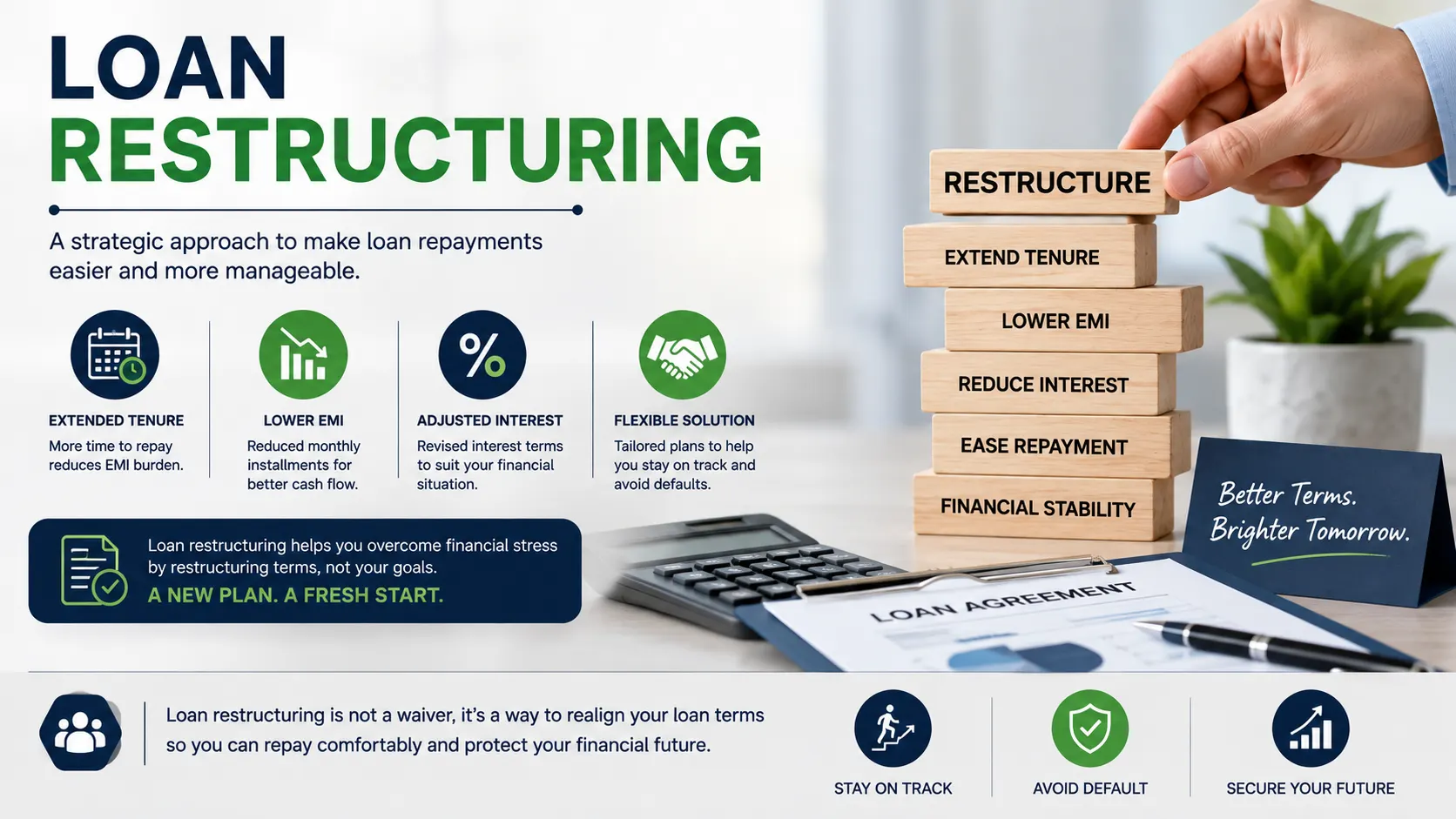
Restructuring refers to a revision of the existing terms of a loan, such as the tenure, interest rate, or instalment amount, undertaken with the objective of rendering repayment more manageable. Critically, the borrower remains obligated to repay the full principal amount over time.
When it is appropriate:
● The borrower has experienced a temporary setback, such as job loss or reduced income, but retains a reasonable prospect of financial recovery.
● The borrower wishes to preserve a favourable credit history and intends to continue availing of credit facilities in future.
Key considerations:
● The Reserve Bank of India periodically issues frameworks under which lenders are required to offer restructuring to genuinely distressed but viable borrowers.
● Restructuring generally has a comparatively limited adverse impact on the borrower’s credit score, particularly where undertaken proactively and in consultation with the lender.
● The overall interest outlay may increase where the tenure is extended, notwithstanding the reduction in the immediate instalment burden.

Loan Settlement
Settlement involves closing the loan account for an amount less than the total outstanding sum, typically pursued once the account has already fallen into default or has been classified as a Non-Performing Asset.
When it is appropriate:
● The borrower has genuinely lost the capacity to repay the loan in full, and restructuring is no longer a viable option.
● The borrower is in a position to arrange a lump-sum payment, even if lower than the total amount owed.
Key considerations:
● A settled account is ordinarily reported to credit information bureaus as “settled” rather than “closed,” a distinction that may adversely affect the borrower’s credit score for a period of years.
● Settlement should be documented in writing, with the lender’s confirmation that no further claims shall be raised upon completion of payment.
● Mechanisms such as Lok Adalat and One-Time Settlement (OTS) schemes offered by banks may facilitate a formal and legally binding settlement.

Bankruptcy and Insolvency Proceedings
Where the borrower’s financial position has deteriorated to the extent that neither restructuring nor settlement is feasible, insolvency proceedings, whether under the Insolvency and Bankruptcy Code, 2016, in respect of eligible entities and individuals, or other applicable statutory frameworks, may become necessary.
When it is appropriate:
● The borrower’s total liabilities substantially exceed their assets and repayment capacity, across multiple lenders.
● Other avenues of resolution have been genuinely exhausted.
Key considerations:
● Insolvency proceedings carry the most severe and long-lasting impact upon the borrower’s credit profile and future borrowing capacity.
● The process is considerably more formal, time-consuming, and typically requires sustained legal representation.
● Certain categories of debt, and specific procedural requirements, apply distinctly to individuals as opposed to corporate entities, and specialist legal advice is essential in navigating this route.

Loan Restructuring vs. Settlement vs. Bankruptcy: Choosing the Right Path
When a borrower finds repayment of a loan to be unsustainable, three principal legal avenues typically present themselves: restructuring, settlement, and, in more severe circumstances, insolvency or bankruptcy proceedings. Each of these mechanisms carries distinct implications
for the borrower’s finances, credit standing, and future borrowing capacity. This article examines the three options in turn, so as to assist borrowers in identifying the course most appropriate to their circumstances.
Loan Restructuring
Restructuring refers to a revision of the existing terms of a loan, such as the tenure, interest rate, or instalment amount, undertaken with the objective of rendering repayment more manageable. Critically, the borrower remains obligated to repay the full principal amount over time.

When it is appropriate:
● The borrower has experienced a temporary setback, such as job loss or reduced income, but retains a reasonable prospect of financial recovery.
● The borrower wishes to preserve a favourable credit history and intends to continue availing of credit facilities in future.
Key considerations:
● The Reserve Bank of India periodically issues frameworks under which lenders are required to offer restructuring to genuinely distressed but viable borrowers.
● Restructuring generally has a comparatively limited adverse impact on the borrower’s credit score, particularly where undertaken proactively and in consultation with the lender.
● The overall interest outlay may increase where the tenure is extended, notwithstanding the reduction in the immediate instalment burden.

Loan Settlement
Settlement involves closing the loan account for an amount less than the total outstanding sum, typically pursued once the account has already fallen into default or has been classified as a Non-Performing Asset.
When it is appropriate:
● The borrower has genuinely lost the capacity to repay the loan in full, and restructuring is no longer a viable option.
● The borrower is in a position to arrange a lump-sum payment, even if lower than the total amount owed.
Key considerations:
● A settled account is ordinarily reported to credit information bureaus as “settled” rather than “closed,” a distinction that may adversely affect the borrower’s credit score for a period of years.
● Settlement should be documented in writing, with the lender’s confirmation that no further claims shall be raised upon completion of payment.
● Mechanisms such as Lok Adalat and One-Time Settlement (OTS) schemes offered by banks may facilitate a formal and legally binding settlement.

Bankruptcy and Insolvency Proceedings
Where the borrower’s financial position has deteriorated to the extent that neither restructuring nor settlement is feasible, insolvency proceedings, whether under the Insolvency and Bankruptcy Code, 2016, in respect of eligible entities and individuals, or other applicable statutory frameworks, may become necessary.
When it is appropriate:
● The borrower’s total liabilities substantially exceed their assets and repayment capacity, across multiple lenders.
● Other avenues of resolution have been genuinely exhausted.
Key considerations:
● Insolvency proceedings carry the most severe and long-lasting impact upon the borrower’s credit profile and future borrowing capacity.
● The process is considerably more formal, time-consuming, and typically requires sustained legal representation.
● Certain categories of debt, and specific procedural requirements, apply distinctly to individuals as opposed to corporate entities, and specialist legal advice is essential in navigating this route.

Concluding Remarks
The appropriate course of action depends substantially upon the borrower’s specific financial circumstances, the nature and number of outstanding liabilities, and the likelihood of future financial recovery. Borrowers are strongly encouraged to seek professional legal and financial advice at the earliest indication of repayment difficulty, as early intervention frequently preserves a wider range of options than would otherwise remain available once an account has fallen significantly into arrears.

Loan Repayment Difficulties: A Guide to Settlement Options and Lok Adalat Proceedings

Loan Settlement in India: Understanding the Process, Lok Adalat and Legal Options

Financial distress can arise due to various reasons, including loss of employment, medical emergencies, business losses, reduced income, or unexpected expenses. When loan repayments become difficult to manage, borrowers may consider loan settlement in India as a possible solution.

Loan settlement is a process through which a borrower and lender agree to resolve an outstanding loan on mutually acceptable terms. Depending on the circumstances and the lender’s policy, the settlement amount may be different from the total outstanding dues. However, borrowers should understand the financial, legal, and credit-related implications before choosing settlement.

What Is Loan Settlement?

Loan settlement generally refers to an arrangement where a lender agrees to accept an agreed amount to resolve an outstanding loan, subject to its approval and applicable policies. It is different from loan restructuring, where the borrower generally continues to repay the loan under modified terms such as a revised repayment schedule or other approved changes.

Loan settlement may be considered when:

  • The borrower is facing genuine financial hardship.
  • Repayment of the entire outstanding amount has become difficult.
  • The loan account has gone into default or may have been classified as an NPA.
  • The lender considers negotiated recovery a practical alternative to prolonged recovery proceedings.

Borrowers should also understand that a settled account may be reported differently from a fully repaid or closed account, which can affect future credit opportunities. Therefore, loan settlement should be considered carefully after evaluating other available repayment or restructuring options.

Lok Adalat for Loan Settlement

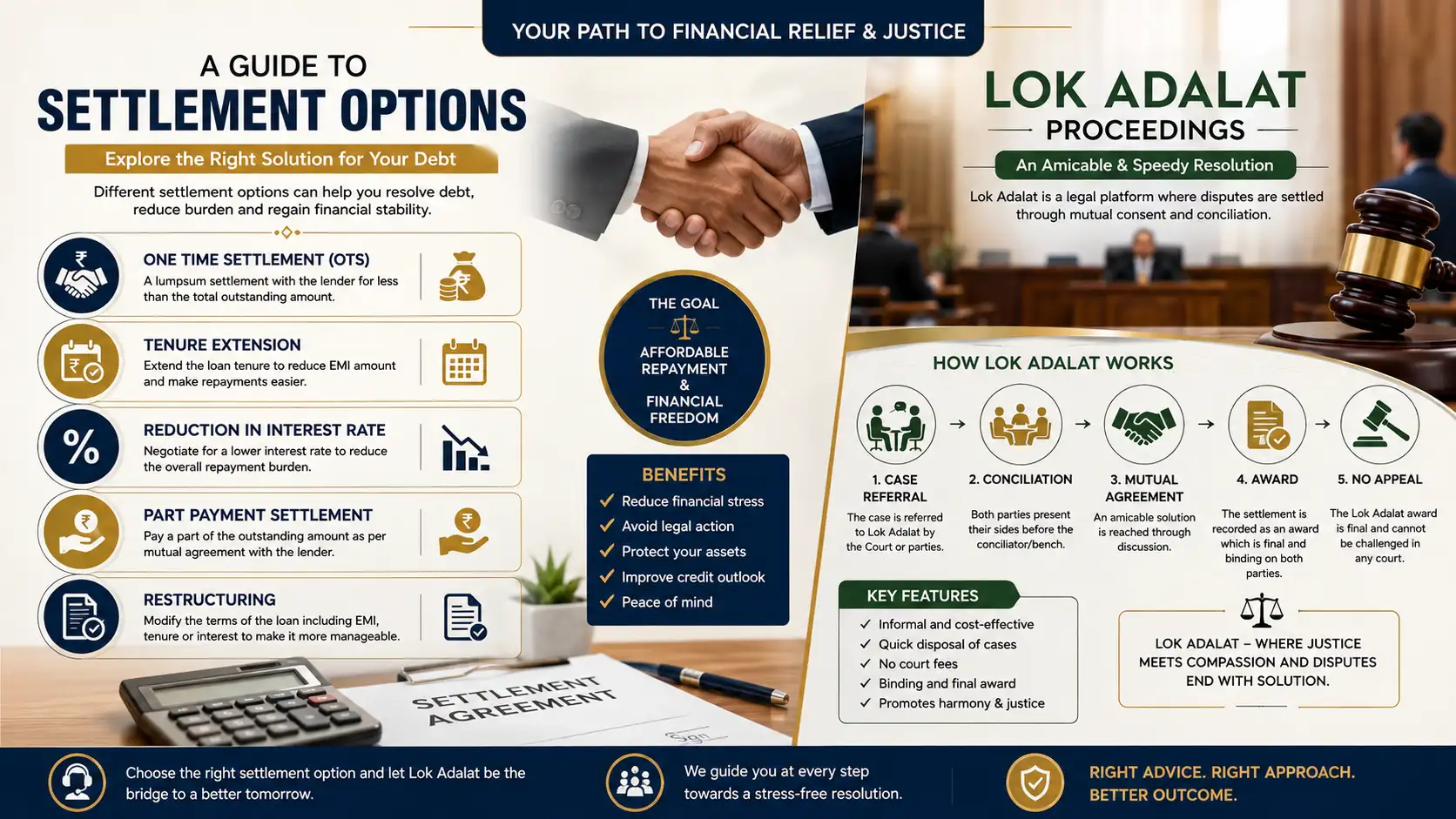
Lok Adalat is an important alternative dispute resolution forum established under the Legal Services Authorities Act, 1987. It provides a platform where borrowers and lenders can attempt to resolve disputes through conciliation and mutual settlement.

Banks, NBFCs, and other financial institutions may participate in Lok Adalat proceedings involving certain loan recovery matters and cheque dishonour cases.

For borrowers searching for loan settlement assistance, Lok Adalat can provide an opportunity to negotiate a mutually acceptable resolution without the prolonged process of regular litigation.

Loan Settlement Process Through Lok Adalat

The general loan settlement process through Lok Adalat may involve the following steps:

  1. Referral of the Case: A pending dispute may be referred to Lok Adalat by the concerned court, lender, or other authorised process.
  2. Notice to the Parties: The borrower and lender receive information regarding the date and venue of the proceeding.
  3. Negotiation: Conciliators facilitate discussions between both parties to explore mutually acceptable settlement terms.
  4. Settlement Award: If an agreement is reached, the terms are recorded in an award in accordance with the applicable legal framework.
  5. Compliance: The borrower must fulfil the agreed payment conditions within the specified timeline.

The exact procedure and availability of settlement depend on the nature of the case and the applicable rules.

Benefits of Loan Settlement

A properly negotiated bank loan settlement may provide several practical benefits for eligible borrowers:

  • It may help resolve prolonged loan disputes.
  • It can provide a structured way to negotiate outstanding dues.
  • It may reduce the immediate financial burden where the lender agrees to settlement terms.
  • It can help bring legal or recovery proceedings toward resolution.
  • It provides documented settlement terms between the borrower and lender.

However, loan settlement is not guaranteed, and lenders are not obligated to accept every settlement proposal.

Other Loan Settlement and Debt Relief Options

Lok Adalat is not the only option available to borrowers. Depending on the loan type, lender, and stage of recovery, other mechanisms may also be relevant.

One-Time Settlement (OTS)

A One-Time Settlement (OTS) is a negotiated arrangement offered by some banks and financial institutions to resolve eligible outstanding loan accounts, particularly certain stressed or NPA accounts. The terms depend on the lender’s applicable policy and approval process.

Loan Restructuring

Loan restructuring may be considered where the borrower has repayment difficulties but may be able to continue servicing the loan under revised terms, subject to lender approval and applicable regulations.

Debt Recovery Tribunal (DRT)

The Debt Recovery Tribunal (DRT) deals with certain debt recovery matters involving banks and financial institutions under the applicable legal framework. Borrowers involved in recovery proceedings should understand their rights and available remedies.

SARFAESI Proceedings

For certain secured loans, the SARFAESI Act, 2002 provides mechanisms for enforcement of security interests by eligible secured creditors, subject to the statutory framework and remedies available to borrowers.

Important Tips Before Loan Settlement

Before entering into a loan settlement agreement, borrowers should take the following precautions:

  • Obtain all settlement terms in writing.
  • Verify the final settlement amount and payment deadline.
  • Understand the potential impact on your credit profile.
  • Keep copies of all correspondence and payment records.
  • Obtain appropriate confirmation or a no-dues document after fulfilling the agreed terms.
  • Do not ignore notices from courts, lenders, or Lok Adalat.
  • Seek professional loan settlement legal advice before signing important settlement documents.

Borrowers should never rely solely on verbal assurances. The final settlement terms should be clearly documented and issued through the appropriate lender process.

Loan Settlement Assistance from Upturn United Consultancy Pvt. Ltd.

Upturn United Consultancy Pvt. Ltd. provides professional loan settlement assistance in India for individuals and businesses dealing with financial difficulties and outstanding loan obligations.

The firm assists clients in understanding their loan position, organising relevant documentation, communicating with lenders, and navigating the loan settlement process. Its broader expertise in banking and finance advisory, corporate law, drafting, arbitration, and litigation support allows clients to receive a more comprehensive approach to financial and legal challenges.

For borrowers considering bank loan settlement, debt settlement, OTS, or other debt relief options, professional guidance can help them understand the available routes and their potential implications.

Conclusion

Loan settlement in India can be a potential option for borrowers facing genuine financial hardship, but it should be approached carefully. Depending on the circumstances, borrowers may consider loan settlement, debt settlement, One-Time Settlement, loan restructuring, or appropriate legal remedies.

Lok Adalat can provide an accessible forum for eligible disputes to be resolved through conciliation and mutual agreement. Understanding the loan settlement process, maintaining proper documentation, and obtaining professional guidance can help borrowers make more informed decisions.

Upturn United Consultancy Pvt. Ltd. supports clients with professional loan settlement assistance, debt management, banking and finance advisory, and related legal services, helping them navigate complex financial situations with greater clarity.

How Does Loan Settlement Affect Your CIBIL Score?

CIBIL Score After Loan Settlement: What Borrowers Need to Know

One of the first questions borrowers ask before choosing a loan settlement is: “What will happen to my CIBIL score after loan settlement?” It is a valid concern because your CIBIL score plays an important role in future loan approvals, credit card eligibility, and the interest rates offered by lenders.

Understanding the impact of loan settlement on CIBIL score and knowing how to rebuild your credit afterward can help you make a more informed financial decision.

What Happens to Your CIBIL Score After Loan Settlement?

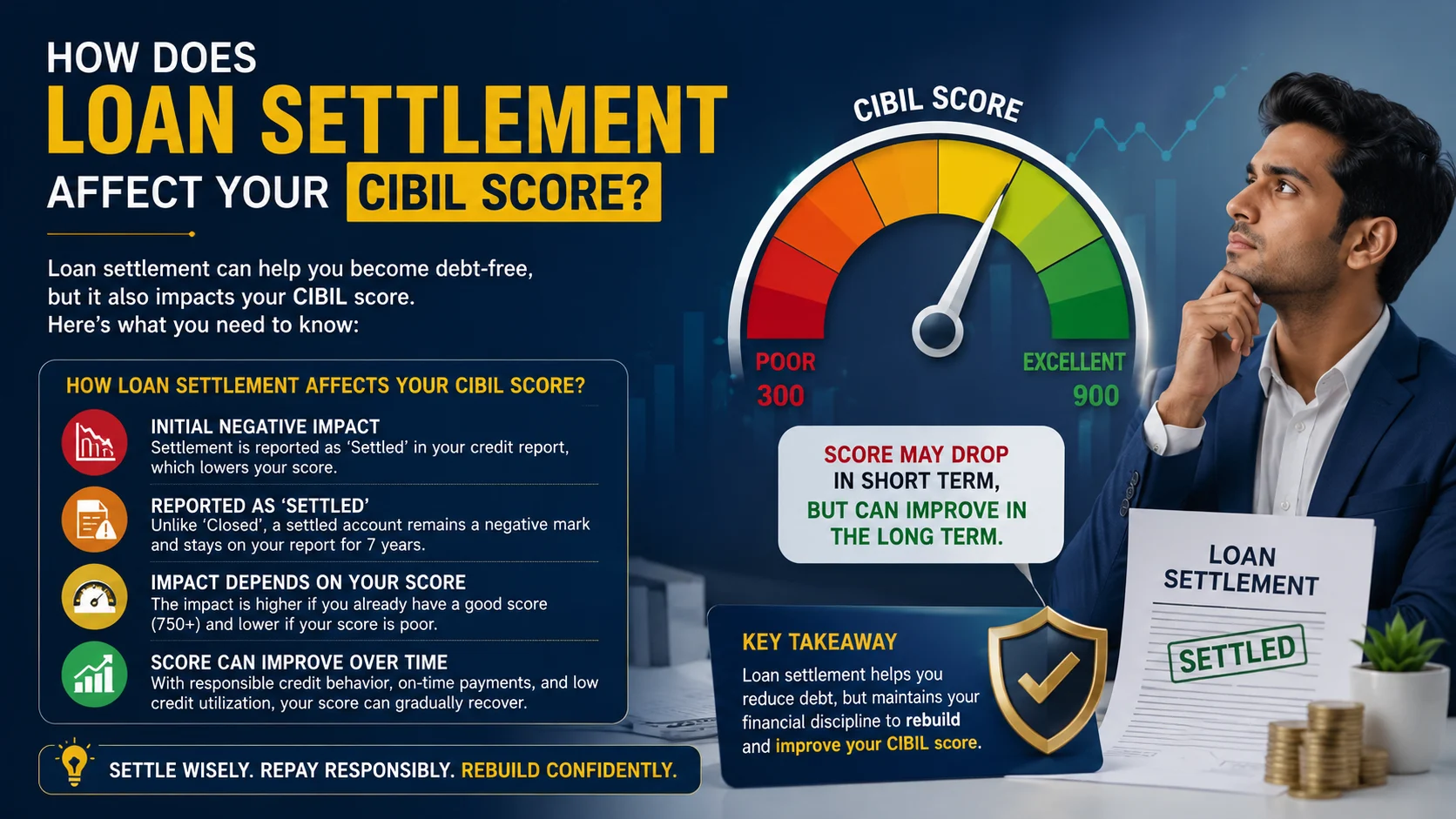
When a borrower settles a loan by paying an amount mutually agreed upon with the lender instead of the entire outstanding balance, the account is generally reported as “Settled” rather than “Closed.”

This distinction is important.

A “Closed” account indicates that the borrower has repaid the loan as agreed. On the other hand, a “Settled” status indicates that the lender accepted less than the total amount originally due.

As a result, loan settlement can negatively affect your CIBIL score. Future lenders reviewing your credit report may consider a settled account a sign of previous repayment difficulties. This can make obtaining loans or credit cards more challenging and may affect the terms offered to you.

Therefore, borrowers should understand the CIBIL score impact of loan settlement before making a decision.

Why Loan Settlement May Still Be the Better Option

The negative impact on your credit score does not necessarily mean that loan settlement is always a bad financial decision.

For borrowers experiencing genuine and prolonged financial hardship, repaying the entire outstanding loan may simply not be possible. In such situations, allowing the account to remain unpaid can result in continued missed payments, collection activity, and potential legal recovery proceedings.

An unresolved default can continue damaging your credit profile while the debt remains outstanding.

In comparison, a properly documented loan settlement can formally resolve the outstanding obligation and provide a clear point from which you can start rebuilding your financial position.

In simple terms, loan settlement may temporarily hurt your CIBIL score, but resolving unmanageable debt can provide a structured path toward financial recovery.

The right decision depends on your individual financial circumstances, the lender’s policies, and the available repayment options.

How to Rebuild Your CIBIL Score After Loan Settlement

The CIBIL score after loan settlement is not necessarily permanently damaged. Your credit profile can improve over time as you demonstrate responsible financial behavior.

Here are some practical steps that may help rebuild your credit:

1. Pay All Existing EMIs on Time

If you have other active loans or credit facilities, make every payment on or before the due date. Consistent repayment history can help establish a healthier credit profile.

2. Use Secured Credit Carefully

A secured credit card backed by a fixed deposit may provide an opportunity to establish a positive repayment history. However, use it responsibly and pay the outstanding balance on time.

3. Avoid Taking Too Much New Debt

Immediately applying for multiple loans or credit cards after settlement may make your credit profile appear financially stressed. Apply for new credit only when genuinely necessary.

4. Check Your CIBIL Credit Report Regularly

Review your credit report to ensure that the information reported by lenders is accurate. If you find incorrect account details, payment information, or outdated entries, consider raising a dispute with the relevant credit bureau or lender.

5. Maintain a Low Credit Utilisation Ratio

If you use credit cards, avoid consistently using a large portion of your available credit limit. Responsible credit utilisation can support a healthier credit profile.

6. Be Patient and Consistent

There is no instant solution for rebuilding a credit score. Responsible repayment habits, controlled borrowing, and regular monitoring are important for long-term credit improvement.

How Long Does It Take to Improve CIBIL Score After Loan Settlement?

The time required to improve your CIBIL score after loan settlement varies from person to person. It depends on factors such as your previous credit history, existing debts, repayment behavior, credit utilisation, and how you manage new credit after settlement.

Instead of focusing only on how quickly the score increases, borrowers should focus on developing consistent financial habits.

Over time, responsible credit management can help demonstrate improved financial stability to future lenders.

How Upturn United Consultancy Pvt. Ltd. Can Help

At Upturn United Consultancy Pvt. Ltd., we understand that loan settlement is not necessarily the end of your financial journey. For many borrowers, it can be a step toward managing an otherwise unmanageable debt situation.

Our loan settlement assistance focuses on helping borrowers understand the settlement process, documentation requirements, and available options based on their circumstances.

We also provide guidance on post-settlement credit management, helping borrowers understand responsible borrowing practices, credit report monitoring, and steps that may support the rebuilding of their credit profile.

The objective is not simply to resolve an outstanding loan but to help borrowers move toward greater financial stability.

Final Thoughts on Loan Settlement and CIBIL Score

The impact of loan settlement on CIBIL score is an important factor that every borrower should consider before making a decision. A settled account can negatively affect your credit profile, particularly because it may be reported differently from a fully closed loan.

However, for borrowers who genuinely cannot repay their outstanding debt in full, continuing an unresolved default may create additional financial and legal difficulties.

If loan settlement becomes necessary, the next priority should be responsible financial recovery. Paying existing obligations on time, avoiding unnecessary borrowing, monitoring your credit report, and maintaining disciplined credit habits can help you work toward rebuilding your CIBIL score.

Loan settlement is not the end of your financial journey. With the right approach, it can become the starting point for rebuilding your financial stability and preparing for future credit needs.

Common Loan Settlement Scams to Avoid

Loan Settlement Scams: Red Flags and How to Protect Yourself

When you’re overwhelmed by debt, the promise of a quick and dramatic solution can be incredibly appealing. Unfortunately, this is exactly what makes borrowers facing financial difficulties a target for loan settlement scams.

The loan settlement and debt relief industry includes legitimate service providers, but borrowers can also encounter fraudulent operators who take advantage of their financial stress. Understanding how loan settlement scams work and knowing the warning signs can help you protect your money, credit profile, and peace of mind.

Why Are Loan Settlement Scams So Common?

Debt settlement can be a legitimate option for borrowers who are struggling to repay their outstanding loans. However, financial distress can make borrowers more vulnerable to misleading promises and aggressive sales tactics.

Scammers may take advantage of this situation by promising guaranteed debt reductions, claiming special relationships with banks, or demanding large upfront payments without clearly explaining what services will actually be provided.

Understanding common loan settlement fraud patterns is one of the best ways to protect yourself.

Common Loan Settlement Scam Red Flags

1. Unrealistic Promises

One of the biggest warning signs of a loan settlement scam is a company guaranteeing an extremely large reduction in your debt without first reviewing your case.

For example, be cautious if a company claims it can reduce 80% or 90% of your outstanding loan regardless of your lender, loan type, financial circumstances, or repayment history.

Legitimate loan settlement outcomes depend on individual circumstances and lender policies. No responsible loan settlement company should guarantee a specific result before properly evaluating your case.

2. Large Upfront Fees

Another important warning sign is a company demanding a significant payment before performing any meaningful work.

Before hiring a loan settlement company, ask exactly how the fees are calculated, when they become payable, and what services are included.

A trustworthy service provider should clearly explain its fee structure instead of asking borrowers to make a large payment based only on promises of future results.

3. False Claims of Bank or RBI Authorization

Be extremely careful if a company claims that it is “officially authorized” by your bank or the RBI to settle your loan.

Private loan settlement consultants are not automatically an extension of your bank simply because they claim to have a relationship with the lender.

Borrowers should independently verify any claim about bank authorization, regulatory approval, or special access to a particular lender.

4. No Written Agreement

A legitimate loan settlement service should clearly explain its services, responsibilities, fees, and terms.

If a company refuses to provide a written agreement or relies entirely on verbal promises, consider it a serious warning sign.

Written documentation gives borrowers a clear understanding of what they are paying for and what services the company has agreed to provide.

5. High-Pressure Sales Tactics

Scammers often create artificial urgency.

Statements such as “sign up today,” “this offer expires tonight,” or “pay immediately or you will lose the opportunity” should make you cautious.

A professional loan settlement company should give you enough time to understand the process, ask questions, review documents, and make an informed decision.

Financial decisions involving significant debt should never be based solely on pressure.

6. Instructions to Stop Paying Your Lender Without a Clear Plan

Another potentially serious warning sign involves being told to immediately stop communicating with your lender or stop making payments without a clear and documented strategy.

Such decisions can have significant consequences, including additional interest, penalties, credit-report impacts, collection activity, and possible legal action.

Before changing your repayment behavior, understand the potential consequences and the complete settlement strategy.

How to Protect Yourself From Loan Settlement Scams

Before choosing a loan settlement company, conduct proper due diligence.

Here are some practical steps:

  • Ask for all important terms and commitments in writing.
  • Understand exactly how the company’s fees work.
  • Ask what services are included in the settlement process.
  • Verify claims about bank relationships or regulatory authorization.
  • Research the company’s reputation and track record.
  • Be cautious about guaranteed settlement amounts.
  • Avoid making decisions solely because of high-pressure sales tactics.
  • Keep copies of agreements, communications, payment records, and settlement documents.
  • Ask questions if any part of the process is unclear.

A trustworthy loan settlement service provider should be willing to answer reasonable questions and explain its process clearly.

Loan Settlement Scams vs. Legitimate Loan Settlement Services

Knowing the difference between a genuine service and a loan settlement scam is important.

Red Flag What a Trustworthy Service Should Do
Guarantees a specific settlement amount Explains that outcomes depend on the individual case and lender
Demands unexplained upfront payments Clearly explains fees and payment terms
Claims special RBI or bank authorization Provides accurate and verifiable information
Avoids written agreements Provides clear documentation
Uses aggressive sales pressure Gives borrowers time to make an informed decision
Provides vague answers Explains the process and responsibilities clearly

No company can eliminate every uncertainty involved in loan settlement. However, transparency, proper documentation, realistic expectations, and clear communication are important indicators of a professional approach.

How Upturn United Consultancy Pvt. Ltd. Can Help

At Upturn United Consultancy Pvt. Ltd., we understand that borrowers dealing with financial stress need clarity, transparency, and professional guidance.

Our approach is focused on helping borrowers understand their loan settlement options rather than making unrealistic promises before reviewing their circumstances.

We believe borrowers should know what they are agreeing to before beginning the settlement process. Therefore, our engagement process focuses on clear communication, documentation, and explaining the applicable steps involved in dealing with banks and NBFCs.

We do not believe in creating unnecessary pressure or making unrealistic guarantees simply to convince someone to sign up.

If you are comparing loan settlement companies, ask questions about their process, documentation, fees, and approach to lender communication. A professional service provider should be comfortable explaining these details.

What to Check Before Choosing a Loan Settlement Company

Before selecting a loan settlement company, consider asking:

  1. What exactly does the company do on my behalf?
  2. How are the fees calculated?
  3. When are the fees payable?
  4. Will I receive a written agreement?
  5. How will communication with the lender be handled?
  6. What documentation will I receive?
  7. Are settlement outcomes guaranteed or dependent on the lender’s decision?
  8. What are the potential consequences of settlement for my credit profile?

These questions can help you distinguish a transparent loan settlement service from potentially fraudulent operators.

Final Thoughts on Loan Settlement Scams

Financial distress can make borrowers particularly vulnerable to loan settlement scams, but taking a few precautions can significantly reduce the risk.

Be skeptical of guaranteed results, unexplained fees, false claims of bank or regulatory authorization, missing documentation, and high-pressure sales tactics.

Most importantly, remember that legitimate debt settlement services should focus on transparency rather than unrealistic promises.

If you are considering loan settlement, take the time to understand the process, verify the service provider, read the agreement carefully, and keep proper records.

At Upturn United Consultancy Pvt. Ltd., our goal is to provide borrowers with a structured and transparent approach to loan settlement assistance. Debt relief should reduce financial pressure — not create another layer of risk.